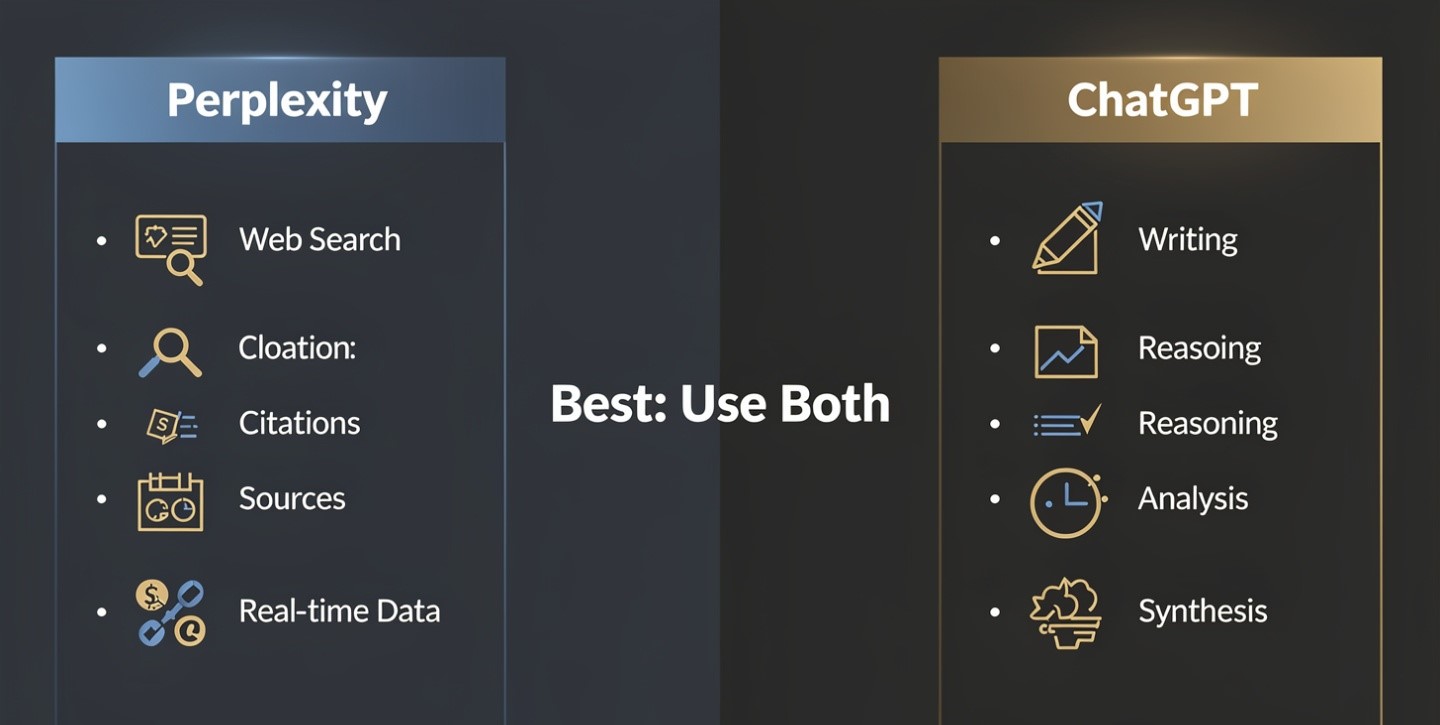
Every Perplexity vs ChatGPT comparison asks which one is more accurate. For fact-checking, that’s the wrong question, because the two tools don’t fail in comparable ways. They fail in opposite ways, and the difference comes from something more basic than model quality: one of them always searches, and the other one decides.
Perplexity retrieves on every query — that’s what the product is. ChatGPT makes a judgement call first. OpenAI’s own documentation puts it plainly: ChatGPT may choose to search the web based on what you ask, or you can select search manually. Which means a ChatGPT answer arrives in one of two completely different states, and the interface does very little to tell you which one you’re holding.
Two failure modes, one visible and one not
When Perplexity gets it wrong, you can usually see the wreckage. There’s a citation, it points somewhere, and if you click it you can check whether the page supports the sentence. Often it doesn’t — that’s the specific problem we dug into in the Perplexity research guide, and it’s a real weakness. But it’s a weakness you can audit in thirty seconds.
When ChatGPT answers from parametric memory, there’s nothing to audit. No links, no sources panel, and an answer that reads exactly like one built from live pages. The failure is invisible, and for fact-checking an invisible failure is strictly worse than a visible one. You can’t verify what you don’t know needs verifying.
| Perplexity | ChatGPT | |
|---|---|---|
| Retrieval | Always | Model decides, or you force it |
| Typical failure | Citation doesn’t support the claim | No retrieval happened at all |
| Visible? | Yes — click through and check | No — same tone either way |
| Worst case | You trust a real source that says something else | You trust a confident answer built from a training snapshot |
| Fix | Verify sentence against source | Force the search, then verify |
What makes ChatGPT search — and how to force it
This is the single most useful thing to know, and it’s testable. A March 2026 analysis of 50 prompts across recent GPT models found that certain prompt shapes triggered search reliably: a year in the query (“in 2026”), a numeric constraint (“under $500”), or a comparison structure (“X vs Y”) produced a search on essentially every attempt. Broad, general-knowledge phrasing frequently did not.
So for any fact-check, do at least one of these:
- Click the globe icon before sending, which forces retrieval regardless of what the model would have chosen.
- Open with “search the web for” or include “as of today” / “in 2026”.
- Add a constraint — a date, a number, a named source.
- Afterwards, ask it to list the URLs it used. If the list is thin or absent, you have your answer about what just happened.
The habit worth building: before you evaluate a ChatGPT answer, establish whether it retrieved anything. If there’s no sources panel and no inline links, you’re looking at a training-data response, and it should be treated as a hypothesis rather than a finding. The general prompting discipline in our ChatGPT features guide applies here, but this specific check matters more than any phrasing technique.
The dangerous middle: citations without retrieval
It would be convenient if “no search” always meant “no citations”. It doesn’t. The same 2026 analysis found one model citing seventeen sources on a product prompt while working from training data alone.
This is the failure that research libraries have been documenting since 2023 and it hasn’t gone away. Duke University Medical Center Library’s guidance makes the mechanism explicit: a predictive text model is not a discovery tool, so a reference it produces without retrieval is reconstructed from patterns rather than pulled from a document. Librarians at Memorial Sloan Kettering described being asked to track down cancer-research citations that turned out not to exist.
What makes these hard to catch is that they’re perfectly formatted — plausible authors, a real-sounding journal, a correctly structured DOI, a URL in the right shape. Format is not evidence. The only test is whether the document opens and says what was claimed. Our fact-checking guide breaks down the seven distinct ways a citation can be wrong; a fabricated one is the easiest of them to catch, and it still catches people daily.
Why running both is a real cross-check
Cross-checking one AI against another is usually bad advice. Two models trained on overlapping data make overlapping mistakes, and agreement tells you almost nothing.
Perplexity and ChatGPT are the partial exception, because when both retrieve, they retrieve from different places. Analyses across platforms consistently find low overlap in cited domains between them, and a Q1 2026 study spanning seven AI platforms concluded there is no universal top source — each platform has its own gravity.
Here’s the honest caveat, and it matters. The composition of those source sets is measured wildly inconsistently. One analysis put Reddit at 1.8% of ChatGPT citations against 6.6% on Perplexity; other studies have put Perplexity’s Reddit share far higher; and one tracker recorded ChatGPT’s Reddit citation share falling from around 60% to around 10% within weeks. These can’t all describe the same thing, and the differences come from query sets and methodology, not from anyone lying. So treat “Perplexity is the Reddit one” as folklore rather than fact.
What survives all that disagreement is the useful part: the overlap is low and unstable. That’s enough to make the two tools genuinely semi-independent instruments, which is all a cross-check needs.
How to use it:
- Both agree, both cite, sources differ → strongest signal available short of reading the primary document.
- Both agree, same source → you have one source, not two. Weak.
- They disagree → this is the finding. Something is contested, stale, or ambiguous. Go to the primary document.
- One cites, one doesn’t → the one that didn’t retrieve isn’t a vote. Discard it and re-run with search forced.
The variance almost nobody uses
There’s a second, free check that requires no second tool at all.
The 2026 prompt analysis found only about 7% citation overlap between two consecutive versions of the same model — and on 22 of 50 prompts, zero overlap. Separately, research into ChatGPT’s retrieval pipeline reported that around 85% of retrieved pages never make it into the final answer, and that less than 10% of the same content was cited across five consecutive runs of the identical prompt.
Read that again: the same prompt, the same tool, five minutes apart, and a mostly different source set. Which means running your fact-check prompt twice is a legitimate test. If the two runs produce the same claim from different sources, that’s corroboration. If the claim itself changes between runs, you’ve learned the answer was never well-supported.
It also means “I checked it with ChatGPT” doesn’t identify a source set. It identifies one draw from a distribution.
Which tool for which claim
| What you’re checking | Start with | Because |
|---|---|---|
| Did this event happen / when | Perplexity | Always retrieves; recency is its native mode |
| Is this statistic real | Both, then the primary source | Numbers travel through summaries and mutate |
| Who said this first | Neither, directly | Both routinely surface syndicated copies over originals |
| Does this paper exist | The publisher or database | Formatted references prove nothing |
| Is this still current policy | ChatGPT with search forced | Add the year; then read the official page yourself |
| Is this claim contested | Both, and compare | Divergence is the signal you want |
| What do real users report | Perplexity | Weights discussion content more heavily |
Notice how often the destination is a primary document rather than either tool. That’s not a failure of the comparison — it’s what both tools are for. They compress the search for what to read. The reading stays yours.
Where neither one helps
Three cases worth naming, because both tools fail together on them:
Commercial and “best tool” queries. The corpus is affiliate-saturated, so retrieval quality can’t exceed it. Both tools will confidently repeat the same marketing.
Anything that looks freshly published but isn’t. Pages labelled “updated 2026” routinely recycle much older facts, and neither tool distinguishes publication recency from content recency. Check the vintage of the figure, not the date on the page.
Claims that are true in a source but wrong in context. A real study, correctly cited, whose finding has been stripped of its conditions. No amount of cross-checking catches this; only reading does. It’s also why measuring anything through AI answers — including competitor research and market research — needs a human pass at the end.
The verdict
For fact-checking specifically, Perplexity is the better default, for one structural reason: it always searches, so its errors are the kind you can find. ChatGPT is better once you’ve forced retrieval and want to keep working with what you found — chaining the check into drafting, analysis or a longer task — and it’s the better general assistant, which is a separate question covered in our three-way assistant comparison.
But the real answer is that this isn’t a choice. Both have free tiers that retrieve. Run the claim through both, treat disagreement as information rather than noise, and spend the time you saved reading the one document that actually settles it. Pricing and daily limits shift constantly on both sides — our Perplexity review covers how to read your own live allowances rather than trusting a tracker.
Frequently asked questions
Is Perplexity or ChatGPT better for fact-checking?
Perplexity, as a default, because it retrieves on every query — so when it’s wrong, there’s a citation you can click and check. ChatGPT may answer from training data with no retrieval and no visual difference in the answer, which is a harder failure to catch. ChatGPT becomes comparable once you force a search.
Does ChatGPT always search the web?
No. OpenAI’s documentation states that ChatGPT may choose to search based on what you ask, or you can select search manually. Broad general-knowledge questions often stay in training data. Prompts containing a year, a numeric constraint, or a comparison structure trigger retrieval far more reliably.
How do I force ChatGPT to search the web?
Click the globe icon before sending, or open your message with “search the web for”, or include phrases like “as of today” or “in 2026”. Afterwards, ask it to list the URLs it used — a thin or missing list tells you retrieval didn’t really happen.
Why do Perplexity and ChatGPT give different sources for the same question?
They retrieve from different places, and their source sets overlap surprisingly little. Analyses across platforms find no universal top source. That low overlap is what makes running both a genuine cross-check rather than asking the same system twice.
Can ChatGPT invent citations?
Yes, when it answers without retrieval. Fabricated references are typically well-formatted — plausible authors, a real-sounding journal, a correctly structured DOI — which is exactly why they get past people. Research libraries have documented tracking down requested articles that turned out not to exist. Format is not evidence; only opening the document is.
Should I run the same fact-check prompt more than once?
Yes, and it costs nothing. Retrieval varies run to run — one analysis found less than 10% of the same content cited across five consecutive runs of an identical prompt. If the claim holds across runs from different sources, that’s corroboration. If the claim itself shifts, it was never well-supported.

1 comment