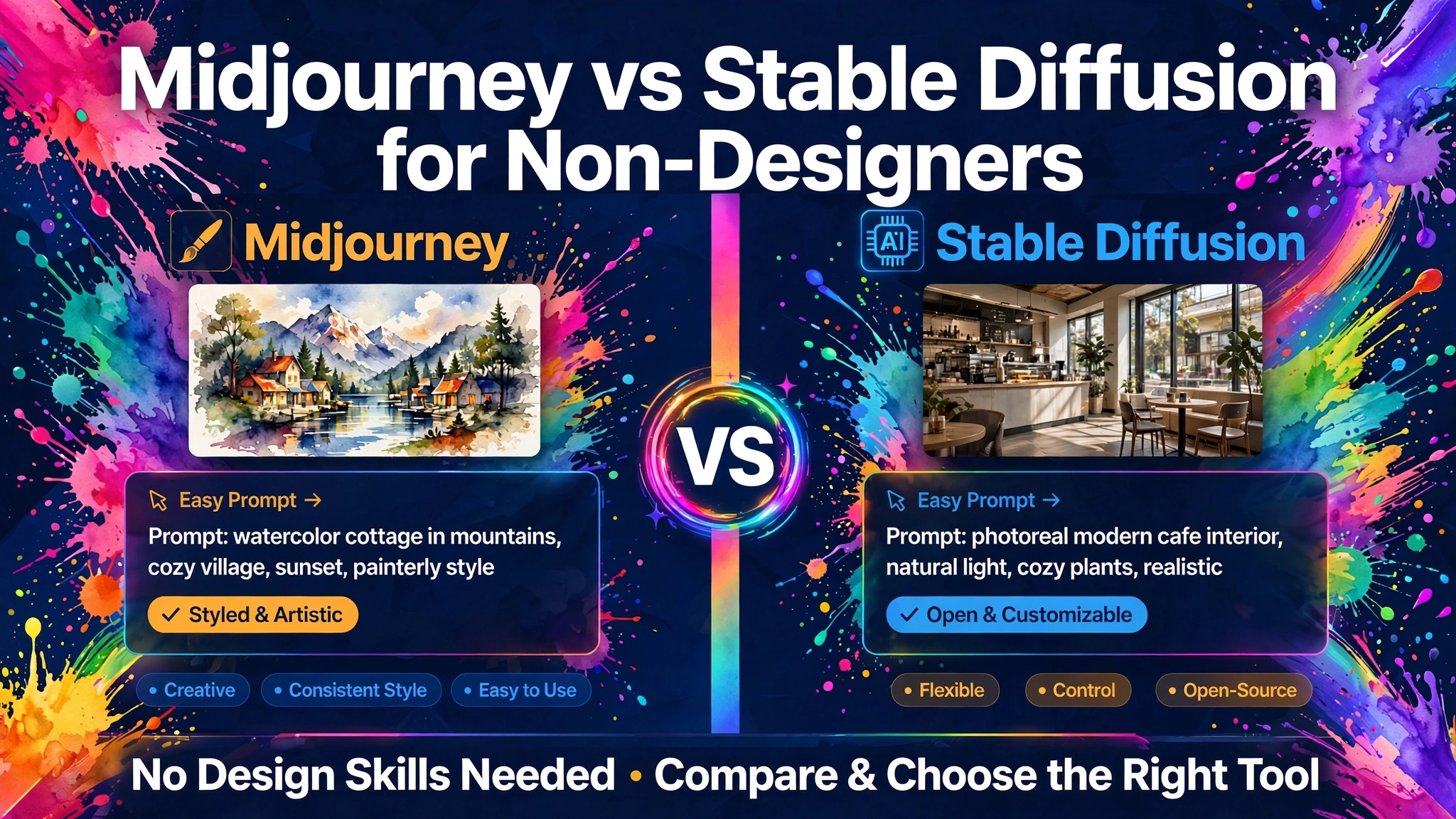
If you’re not a designer, this isn’t a comparison of two image generators. It’s a choice between renting a finished product and assembling a supply chain.
Midjourney is one subscription, one interface, one bill, and someone else’s roadmap. Stable Diffusion is free model weights plus a toolchain you assemble, hardware you buy, a licence you genuinely have to read, and a flagship model that hasn’t been updated since October 2024.
Almost every comparison you’ll find scores them on image quality. That’s the least decision-relevant axis available in 2026.
“Free” is a licence status, not a price
Stable Diffusion’s model weights cost nothing to download. That is where free ends.
To generate anything locally you need a GPU. Reported figures put a used RTX 3060 with 12GB of VRAM around $200–250, and a new RTX 4090 near $1,600. Older, smaller models will run on 4GB of VRAM, but output quality on 6–8GB cards degrades at higher resolutions or once you chain ControlNet stages; 12GB and above handles 1024×1024 with ControlNet without that penalty. Electricity is a real but variable cost that scales with generation volume and card wattage.
Then there’s the part that doesn’t show up on any spec sheet:
| Cost | Midjourney | Stable Diffusion (self-hosted) |
|---|---|---|
| Hardware | None | $200–1,600+ GPU |
| Setup | Minutes | Python environments, drivers, checkpoint downloads |
| Per image | Included in subscription | Electricity only |
| Maintenance | None | Yours — models, nodes, dependencies |
| Learning curve | Prompting | Prompting plus a node-based pipeline |
ComfyUI’s node graph, which is how most serious Stable Diffusion work happens now, is closer to building a small pipeline than to using an app: base generation feeding refinement feeding upscaling, all wired together. That’s genuinely powerful. It is also software work, and calling it “free” while ignoring the hours is the central dishonesty of most write-ups aimed at non-designers.
The licence clause almost nobody reads
This is the part worth the whole article.
SD 3 and 3.5 are released under the Stability AI Community License. It’s free for research and non-commercial use, and free for commercial use by organisations under $1 million in annual revenue. Above that, you need an Enterprise licence quoted privately by Stability’s sales team.
Three details inside that clause change who it applies to:
It’s total revenue, not AI revenue. The licence text refers to generating more than $1,000,000 in annual revenue regardless of whether that revenue is generated directly or indirectly from the materials. So a profitable business that uses Stable Diffusion only for blog headers is measured on its whole turnover, not on the images.
It aggregates across affiliates — individually or in aggregate, per the licence.
Crossing the line terminates the licence. The text states that any licences granted terminate as of the date the threshold is passed. Not “you should upgrade” — terminated (licence text).
There are also two obligations people miss: commercial users are required to register with Stability AI, and reporting indicates a “Powered by Stability AI” attribution notice is expected.
Now the fork that actually matters for a small business. SDXL and earlier checkpoints use the older, permissive CreativeML Open RAIL-M licence, with no revenue cap at all. That’s why a large part of the community simply stayed on SDXL after the newer terms landed — and why “can I use Stable Diffusion commercially” has no single answer. It depends entirely on which checkpoint you loaded, which is not a question Midjourney ever asks you (licence analysis).
Note that this is a licence question — separate from whether you own the output and separate from third-party infringement risk. Those three get merged constantly; they’re pulled apart properly in Midjourney vs Adobe Firefly on commercial use.
Three products, one name
Part of why comparisons go wrong is that “Stable Diffusion” refers to at least three different commercial arrangements:
| Route | What it costs | Who it suits |
|---|---|---|
| Self-host under the Community License | No licence fee under $1M revenue; hardware and time are yours | Technical users, privacy-sensitive work, high volume |
| Enterprise licence | Quoted privately | Companies over the threshold |
| Stability’s hosted API | Credits, reported around $0.01 each; SD 3.5 images reported at roughly 2.5–6.5 credits, with a cheaper Flash tier from about $0.025 per image | Developers who want the model without the machine |
If you’re paying per image through the API, you’ve rebuilt a subscription with extra steps — and you should compare it against Midjourney’s monthly cost directly rather than treating one as “free” and the other as paid.
The frozen flagship problem
Here’s the fact most 2026 comparisons omit, and it cuts against the open route.
Stable Diffusion 3.5 was released in October 2024, and as of mid-2026 it’s still the current flagship. Stability has continued to describe it as its most powerful image model, and no successor image model has been announced. The company’s releases since have gone elsewhere — Stable Audio 3.0 in May 2026, and Brand Studio, an enterprise creative platform, in April 2026 (model timeline).
Context helps explain that. Stability went through a difficult 2024 — a founder departure, heavy reported losses, then new leadership, fresh investment and debt cleared — followed by a clear pivot toward enterprise products.
So the open-weights route means committing to a model roughly two years old while the hosted competitors shipped multiple generations. The community’s answer has largely been FLUX from Black Forest Labs, a newer open model family that absorbed a lot of the momentum. Which is worth saying plainly: if you’re choosing the open route in 2026 for capability reasons, Stable Diffusion may not even be the open model you want.
What Midjourney gives a non-designer
One bill, no hardware, no assembly, and a model that keeps moving without you doing anything. For someone whose job is not image generation, that bundle is worth more than any quality delta.
It has its own constraints, and they’re worth knowing before you subscribe rather than after. Generations are public by default on lower tiers, which makes the private-capable tiers a floor rather than a luxury for client or NDA work. There’s a revenue-linked rule that pushes higher-earning commercial users up the plan ladder. And there’s no offline option at all — every image passes through someone else’s servers, which is a hard stop for some employers.
The fuller picture on where it sits against the other hosted options is in Midjourney vs DALL·E vs Firefly, and if what you actually need is design output rather than raw generation, Canva AI vs Adobe Firefly for non-designers is closer to the real question.
Who should pick which
| If you | Choose | Why |
|---|---|---|
| Need a few good images a week and aren’t technical | Midjourney | The assembly cost of the alternative exceeds any saving |
| Generate thousands of images a month | Stable Diffusion, self-hosted | The GPU amortises fast; this is the strongest case for open weights |
| Can’t send client material to a third-party server | Stable Diffusion, self-hosted | The only genuinely offline option here |
| Need to fine-tune on a specific product, face or style | Stable Diffusion | Custom training isn’t available on the hosted route |
| Run a business over $1M in revenue | Midjourney, or SDXL, or an Enterprise licence | SD 3.5’s Community License doesn’t cover you |
| Want the most current open model | Look beyond Stable Diffusion | The flagship has been static since late 2024 |
The honest recommendation
For a non-designer, Midjourney nearly always. Not because it produces better images — that gap narrowed years ago — but because the total cost of the alternative is a GPU, a weekend, a licence you have to interpret correctly, and ongoing maintenance of a pipeline that is not your job.
Stable Diffusion becomes the right answer at three specific moments: when volume is high enough that per-image cost dominates, when the work genuinely cannot leave your machine, or when you need to train the model on something of your own. Those are real cases. They’re just not “I need images for my blog.”
And whichever you pick, remember what a subscription actually buys, which is the framing that runs through cutting business costs with AI: you’re paying to not become the integration. Sometimes that’s excellent value. If you’re assembling a wider stack, the best AI tools for small business owners is the map, the Adobe Firefly review covers the third route, and for a specific common job, creating a logo with AI and AI tools for content creators deal with what you’ll actually do with the output.
Frequently asked questions
Is Stable Diffusion really free for commercial use?
It depends on the model version and your company’s revenue. SD 3 and 3.5 are free for commercial use under the Stability AI Community License only while your organisation is under $1 million in annual revenue, measured on total revenue rather than AI-related revenue and aggregated across affiliates. SDXL and earlier checkpoints carry no revenue cap under their older permissive licence.
What happens if my business passes $1 million in revenue?
The licence text states that licences granted under the agreement terminate as of that date, and continued commercial use of SD 3 or 3.5 requires an Enterprise licence quoted privately by Stability AI. Note the threshold is total company revenue, so a business that uses the model only incidentally can still cross it.
What hardware do I need to run Stable Diffusion locally?
Older models will run on around 4GB of VRAM, but quality degrades on 6–8GB cards at higher resolutions or with ControlNet chains active. A 12GB card handles 1024×1024 with ControlNet cleanly — a used RTX 3060 12GB has been reported around $200–250, with high-end cards near $1,600. Electricity is an additional variable cost.
Is Stable Diffusion still competitive in 2026?
Its flagship hasn’t moved. SD 3.5 was released in October 2024 and Stability still presented it as its most powerful image model in mid-2026, with no successor announced; the company’s newer releases have been in audio and enterprise products. Much of the open-model community has shifted attention to newer families such as FLUX.
Which is cheaper overall, Midjourney or Stable Diffusion?
At low volume, Midjourney — once you count a GPU, setup time and ongoing maintenance. At high volume, self-hosted Stable Diffusion, because the hardware amortises and marginal cost is only electricity. Using Stability’s hosted API instead puts you back on per-image pricing, which should be compared with a subscription directly rather than described as free.
Can a non-designer realistically learn Stable Diffusion?
Yes, but budget for it honestly. Beyond prompting, local use involves GPU drivers, Python environments, model checkpoints and usually a node-based pipeline. That’s software work rather than app usage. If image generation isn’t a core part of your role, the hosted route is almost certainly the better use of your time.