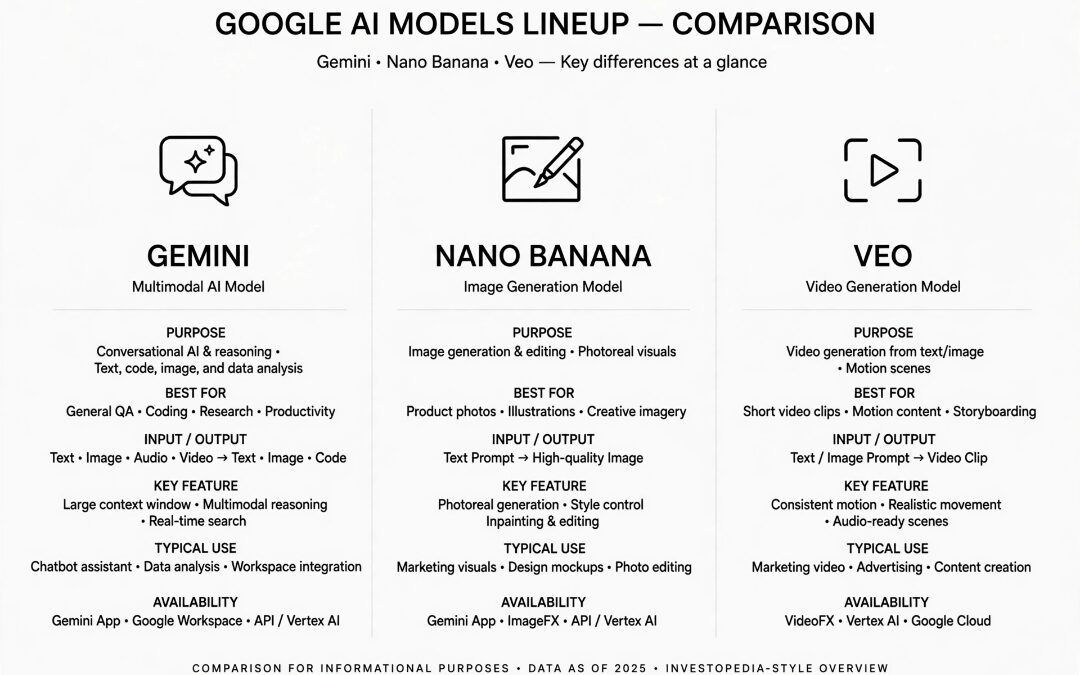
Google’s AI lineup splits into distinct product lines that update on separate schedules: Gemini (text and reasoning, currently spanning 3.1 Pro down to 3.8 Flash), Nano Banana (images), Veo (video), NotebookLM (research synthesis), Gemma (open-weights), and Gemini Nano (on-device). The fastest way to pick correctly is by job, not by model name — names change speed and capability independently, and picking by number alone can get you the wrong tier.
Search “google ai models” today and you’ll get half a dozen confident explainers, several of them contradicting each other about which model is currently on top. That’s not because the writers are careless. It’s because Google’s own catalog moves at a pace that outruns documentation — including, at times, Google’s own marketing pages.
Google’s AI Catalog Ships on at Least Two Different Clocks
The single most useful fact for picking a Google Gemini model isn’t a benchmark score — it’s the release cadence of the tier you’re looking at, because “current” means something different depending on which line you’re in.
The everyday Flash tier has shipped four times in under four months:
| Model | Released | Gap from prior Flash release |
|---|---|---|
| Gemini 3.5 Flash | May 19, 2026 | — |
| Gemini 3.6 Flash | Jul 21, 2026 | 63 days |
| Gemini 3.7 Flash | Aug 13, 2026 | 23 days |
| Gemini 3.8 Flash | Sep 2, 2026 | 20 days |
The flagship reasoning tier has moved once in that same window. Gemini 3.1 Pro shipped February 19, 2026, replacing the short-lived 3 Pro from November 2025 — and as of this writing, seven months later, no successor has appeared. Gemini 3 Deep Think, the dedicated hard-math-and-logic mode built on top of Pro, got one major upgrade in February and has held steady since, gated behind the $250/month Ultra plan.
None of this is a knock on Google. Flash-tier models are cheap to retrain and ship because they’re smaller; frontier reasoning models take longer to validate. But it means “which Gemini model is newest” and “which Gemini model is best” are answering two different questions, and most headlines conflate them. A model that shipped three weeks ago in the Flash tier is not automatically more capable than one that’s sat in the Pro tier for seven months — it’s just cheaper and faster to update.
Worth a direct check before you take any explainer’s word for it, including this one: Google’s own regional subscription pages don’t always agree with each other in real time. Search Google’s 3.1 Pro announcement against its live subscription pages and you’ll sometimes find a cached regional page still advertising an older Pro model as the “highest access” tier, months after the newer one shipped. That’s a caching lag on Google’s side, not a conspiracy — but it’s a reminder that even the source can be out of sync with itself.
The Nano Banana Naming Trap
Nano Banana’s naming is where most casual guides get a reader into real trouble, because the consumer nickname doesn’t track the underlying Gemini generation in the order you’d assume.
| Consumer name | Actual Gemini model | Released | Tier |
|---|---|---|---|
| Nano Banana | Gemini 2.5 Flash Image | Aug 26, 2025 | Flash |
| Nano Banana Pro | Gemini 3 Pro Image | Nov 20, 2025 | Pro |
| Nano Banana 2 | Gemini 3.1 Flash Image | Feb 26, 2026 | Flash |
| Nano Banana 2 Lite | Gemini 3.1 Flash-Lite Image | Jun 30, 2026 | Flash-Lite |
“Nano Banana 2” launched three months after “Nano Banana Pro” and the “2” naturally reads as a sequel to Pro. It isn’t. It’s built on the Flash line, not Pro, and Google’s own documentation shows it’s a genuinely different tool: Nano Banana 2 supports a larger 131,072-token input context (useful for feeding it more reference material), while Nano Banana Pro caps at 65,536 tokens but is the one built for precise text rendering and complex multi-turn edits using up to 14 reference images.
If your job needs Nano Banana Pro’s reasoning-heavy composition and you grab “2” because the number sounds newer, you’ll get faster, cheaper output that’s a step down on exactly the thing you needed. Check the tier, not the number, especially since it also comes up in our Nano Banana Pro vs. Midjourney comparison, which goes deeper on what Pro-tier image reasoning actually buys you.
Pick by Job
Once you separate “current” from “capable,” matching a task to a model line is straightforward:
| Job | Model line | Note |
|---|---|---|
| Everyday chat, drafting, quick lookups | Gemini Flash (currently 3.8 Flash) | Free-tier eligible; check release notes for anything newer before you rely on a specific version number |
| Complex reasoning, long documents, agentic workflows | Gemini Pro (3.1 Pro) | Hasn’t moved since February — that’s normal for this tier, not a sign it’s stale |
| Hardest math, science, multi-step logic | Gemini 3 Deep Think | Ultra subscription only; minutes-long response time by design |
| High-volume, low-stakes tasks (classification, simple translation) | Gemini Flash-Lite (3.5 Flash-Lite) | Optimized for cost, not depth |
| Image generation needing precise text or complex multi-turn edits | Nano Banana Pro (Gemini 3 Pro Image) | Not superseded by “Nano Banana 2” — different tier, different job |
| Image generation, faster and cheaper, good enough for most edits | Nano Banana 2 (Gemini 3.1 Flash Image) | Larger input context than Pro, less reasoning depth |
| Video generation | Veo 3.1 | The only Veo generation Google still actively supports |
| Synthesizing many documents into one research workspace | NotebookLM | Built on Gemini, but a separate product with its own interface |
| On-device, offline, privacy-sensitive light tasks | Gemini Nano | Runs locally on supported Android devices and Chrome |
| Self-hosted, open-weights deployment | Gemma 4 | Separate from Gemini’s hosted API entirely |
For a sense of how Flash-tier releases stack up against each other on real output rather than release date, our Muse Spark vs. Gemini Flash comparison is a useful companion — it’s the same “newest doesn’t mean best” pattern showing up between competing vendors, not just within Google’s own catalog.
What’s Already Retired (and Some Guides Still Recommend)
Two retirements matter if you’re reading anything published before mid-2026 about Google’s image or video models:
- Imagen 4 developer endpoints were discontinued for new projects in June 2026. Google now steers new development toward Gemini-based image models — the Nano Banana family — instead. Existing Imagen integrations weren’t necessarily killed outright, but new builds shouldn’t start there.
- Veo 2 and Veo 3 are being retired by June 30, 2026, with Veo 3.1 as the sole remaining generation. Veo 2 was silent-only at 720p; Veo 3 added audio; 3.1 added 4K, video extension, and start/end-frame control. Any comparison table still listing Veo 2 or Veo 3 as live options should be treated as dated, and per independently tracked pricing breakdowns, Veo 2 was actually pricier per second than the newer, more capable Veo 3.1 — a pure legacy-tax, not a budget option.
Who Shouldn’t Just Wing This from a General Guide
If you’re building a product against a specific model string in production — not just using the consumer app — this article, and every article like it, is the wrong source of truth for the day something changes. Google’s own deprecations and lifecycle page is the only place that tracks individual endpoint retirement dates, and those retire on their own schedule regardless of what’s still “current” for consumer users. Teams shipping against the API should check that page before every release, not rely on a blog post’s snapshot.
If you’re an occasional user picking a tool for a single task, you don’t need any of that. Match the job to the table above, use whatever’s live in the Gemini app or AI Studio today, and move on — the naming confusion above is the part actually worth remembering, not the exact version numbers, which will be different again in a few weeks. That instability is also why static “best AI tools” directories go stale faster than most readers expect, and why benchmark leaderboards disagree with each other even when they’re citing the same model.
One more practical wrinkle if you’re comparing Google’s models to competitors on price: Google’s reasoning models, like most frontier models now, bill “thinking” tokens at full output rate even though you don’t see them — a cost mechanic we’ve broken down separately that applies to Gemini Pro and Deep Think the same way it applies to every other provider’s reasoning tier. It’s easy to miss when you’re only comparing sticker price against ChatGPT or another assistant on a per-message basis.
Frequently Asked Questions
Is Nano Banana 2 an upgrade to Nano Banana Pro?
No. Despite launching after Nano Banana Pro and carrying the “2,” it’s built on Gemini’s Flash tier, not Pro. It’s faster and cheaper with a larger input context, but Nano Banana Pro remains the stronger choice for precise text rendering and complex multi-turn edits.
What’s the current Gemini flagship model?
Gemini 3.1 Pro, released February 19, 2026, is still the top standard reasoning model as of this writing, with Gemini 3 Deep Think as the Ultra-only mode for the hardest problems. Because the Pro tier updates far less often than Flash, this is less likely to have changed than most other entries in Google’s catalog — but it’s worth a quick check against Google’s release notes before you commit to it for anything production-critical.
Can I still use Veo 2 or Veo 3?
Google is retiring both by June 30, 2026, with Veo 3.1 as the replacement. Any tool or guide still pricing out Veo 2 or Veo 3 as a live option is working from outdated information.
What’s the difference between Gemini and Gemma?
Gemini is Google’s hosted model family, accessed through the Gemini app, API, or Vertex AI. Gemma is a separate line of open-weights models you download and run yourself, aimed at developers who need local or self-hosted deployment rather than a managed API.
Is Google Gemini free to use?
Yes, with usage limits, through the free tier of the Gemini app. Google AI Pro ($19.99/month) and Google AI Ultra ($249.99/month) raise those limits and unlock higher-tier models like Deep Think and expanded Veo access.
Why do different sites list different “current” Google AI models?
Because Google’s release cadence varies wildly by tier — Flash-line models ship every few weeks while Pro-line models can sit unchanged for months — any explainer, including official Google marketing pages, can be accurate on the day it’s written and outdated a few weeks later without anyone having made an error.
Shurah is the founder of AI Tools Daily, tracking pricing, licensing and policy changes across AI tools so readers can make decisions without wading through marketing claims themselves.