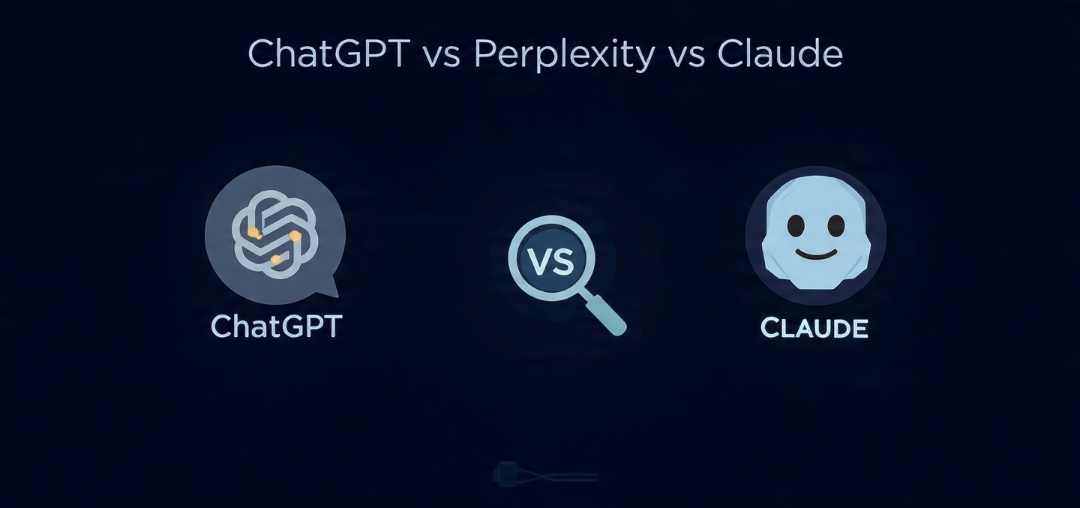
“Which AI is best for research” has no answer, because research isn’t one task. It’s three, and they have almost nothing in common.
Discovery — finding out what exists on a topic. Verification — checking whether a specific claim is true. Synthesis — reasoning across material you’ve already gathered to produce something new.
Each of these three tools was built around a different one. Most people pick one and use it for all three, which is the single biggest reason AI-assisted research feels unreliable. The tool isn’t failing; it’s being asked to do a job it wasn’t shaped for.
The one-line difference between them
Strip away model names and benchmark scores and you get a clean split based on where the material comes from:
- Perplexity goes and gets it. Every query triggers retrieval. It’s a search engine with a writer attached.
- ChatGPT decides whether to. OpenAI’s documentation says so plainly — it may choose to search based on what you ask, or you can force it.
- Claude works on what you bring it. Its centre of gravity is documents you upload, not pages it finds.
That maps onto the three stages almost exactly.
Stage one: discovery
Perplexity is the default here, and it’s not close. Guaranteed retrieval means you never get a confident answer built from a training snapshot, and the whole interface is organised around sources rather than around conversation. Our guide to driving it well covers the corpus-control techniques that matter more than prompt phrasing.
Where it gets interesting is the agentic “deep research” modes, which all three now have and which are not the same product:
| Runs for | Produces | Wrong choice when | |
|---|---|---|---|
| Perplexity Deep Research | ~2–4 minutes | A cited report from dozens of searches across hundreds of sources | You need depth on a narrow question rather than breadth |
| ChatGPT Deep Research | Up to ~30 minutes | A long written report, thousands of words, hundreds of pages read | You needed an answer today, or you won’t read 4,000 words |
| Claude’s research mode | Varies | Fewer citations per minute; stronger reasoning about what it found | You’re doing a literature sweep and want volume |
The trap common to all three: the longer the report, the smaller the fraction of it you’ll actually check. A thirty-minute run with sixty citations gets spot-checked at three of them. Length reads as rigour and isn’t. Treat a deep research report as an annotated reading list, not as a finding.
Stage two: verification
This is its own discipline and we’ve covered it properly in Perplexity versus ChatGPT for fact-checking, so the short version here: the two tools fail in opposite ways, one visibly and one invisibly, and running a claim through both is a genuine cross-check because their source sets barely overlap.
The one rule worth repeating in any context: a citation tells you a page was retrieved, not that the page supports the sentence attached to it. Everything else in the fact-checking guide follows from that.
Stage three: synthesis
This is where Claude earns its place, and where the other two struggle for a structural reason rather than a quality one: they’re optimised to find material, and synthesis operates on material you already have.
The workload that shows the difference: upload five papers on the same topic and ask for a comparison table of methodologies, sample sizes, findings and limitations. Or upload a contract and a technical specification and ask whether the contract terms actually match the requirements. These need sustained attention across long context and — critically — tracking which claim came from which document. That last part is what separates synthesis from summarising, and it’s what a search-first tool isn’t built to do, because in its world every claim came from a page it just found.
Practitioners who do a lot of this converge on the same arrangement: narrower tools to find things, Claude as the layer that reads everything and writes the memo. Projects keep the uploaded corpus persistent across sessions, so the research doesn’t reset when you close the tab.
Two caveats worth taking seriously. First, the most-named failure mode is over-stuffing context — dumping fifty documents in and asking a vague question. More material with a loose question produces worse output than less material with a sharp one. Second, a bigger context window improves what the model can retrieve more than what it can reason about, which is the finding at the centre of our long-documents guide and the reason a two-pass extract-then-reason method beats a single sweeping prompt.
The handoff is the whole workflow
One rule makes the three-tool approach work: carry documents between stages, not summaries.
If you take Perplexity’s summary into Claude and ask it to analyse, you’re analysing a compression of a compression. Take the sources instead. The discovery stage’s job is to tell you what to read; the synthesis stage should read it.
- Discover. Perplexity, or a deep research run if the topic is broad. Output: a list of documents worth opening.
- Triage. You, for ten minutes. Which five actually matter.
- Collect. Download or save those five. Actual files, not links.
- Synthesise. Upload them to Claude with a specific question. Ask it to attribute every claim to a document.
- Verify. Spot-check the three load-bearing claims against the originals.
Steps two and five are the human ones and they’re the reason the output is any good. This is the same pattern that keeps AI-assisted market research honest: the tools compress the search, not the judgement.
Don’t buy on specs
An honesty note that should change how you read every comparison in this category, including this one.
Sources published within weeks of each other in 2026 give Claude a 200,000-token context window and a one-million-token context window; refer to Claude 4.6 and Claude Opus 5 as though they’re the current model; cite GPT-5.4 and GPT-5.6; and disagree on which model tops which benchmark index. They’re all describing real things — just from different release moments, different tiers, and different measurement methodologies that treat “context window” and “current model” inconsistently.
The practical consequence: don’t choose between these on numbers you read anywhere. The stage-based split above is stable across releases; the specs aren’t stable across months. If a comparison’s argument depends on a specific token count or benchmark position, it has a shelf life measured in weeks. We hit the same wall comparing Gemini and ChatGPT and reached the same conclusion.
What this costs
All three sit at roughly $20 a month at the consumer tier, with free tiers that genuinely work for evaluation — Perplexity’s free tier retrieves, Claude’s free tier accepts file uploads, ChatGPT’s free tier searches when it decides to.
Which means running two of them costs about $40 and, for research specifically, buys more than upgrading either one to a higher tier. The pairing most people land on is Perplexity for discovery and Claude for synthesis, with whichever general assistant they already pay for handling everything else. Perplexity’s higher enterprise tiers exist and are priced accordingly, but nothing about a research workflow requires them — our Perplexity review covers how to read your own live limits before assuming you need more.
Pick by what you’re doing today
| The task | Use |
|---|---|
| What’s been published on this topic? | Perplexity |
| Is this specific claim true? | Perplexity and ChatGPT, compared |
| Read these eight PDFs and find the contradictions | Claude |
| Do these two documents actually agree? | Claude |
| Write me a broad report on an unfamiliar area | ChatGPT Deep Research |
| What changed in this field last month? | Perplexity |
| Turn my notes and sources into a memo | Claude |
| General assistant that also does research adequately | ChatGPT |
If you only want one, the honest answer depends on which stage dominates your week — and for most people doing real research, that’s synthesis, because discovery was never the hard part. For the broader assistant comparison beyond research, see the three-way general comparison, and this deep-research tracker is the least stale place to check what each mode currently does.
Frequently asked questions
Which is best for research: ChatGPT, Perplexity or Claude?
It depends which stage of research you mean. Perplexity is best at discovery because it retrieves on every query. Claude is best at synthesis across documents you upload, including tracking which claim came from which source. ChatGPT sits between them and is the strongest general assistant of the three.
What’s the difference between the deep research modes?
Perplexity’s runs roughly two to four minutes across dozens of searches and hundreds of sources for a cited report. ChatGPT’s can browse for up to about thirty minutes and produce a much longer written report. Claude’s returns fewer citations per minute but reasons more carefully about what it found.
Should I use Claude for finding sources?
Generally no. It returns fewer citations per minute than search-first tools, and discovery is the stage where volume matters. Use Perplexity or a deep research run to find material, then bring the actual documents to Claude for analysis.
Can I just pass a Perplexity summary to Claude?
You can, but you’ll be analysing a compression of a compression. Carry the source documents between stages rather than the summaries. The discovery stage’s job is to tell you what to read; the synthesis stage should read it.
Why do comparisons disagree about context windows and model versions?
Because these products change every few weeks and reviewers describe different release moments, different subscription tiers and different measurement conventions. Sources published within weeks of each other in 2026 cite both 200,000 and one million tokens for the same assistant. Don’t pick a tool based on a spec you read in an article.
Do I need to pay for all three?
No. All three are roughly $20 a month with usable free tiers. Most people who do serious research pay for two — typically one discovery tool and one synthesis tool — which costs around $40 and delivers more than upgrading a single tool to a higher tier.