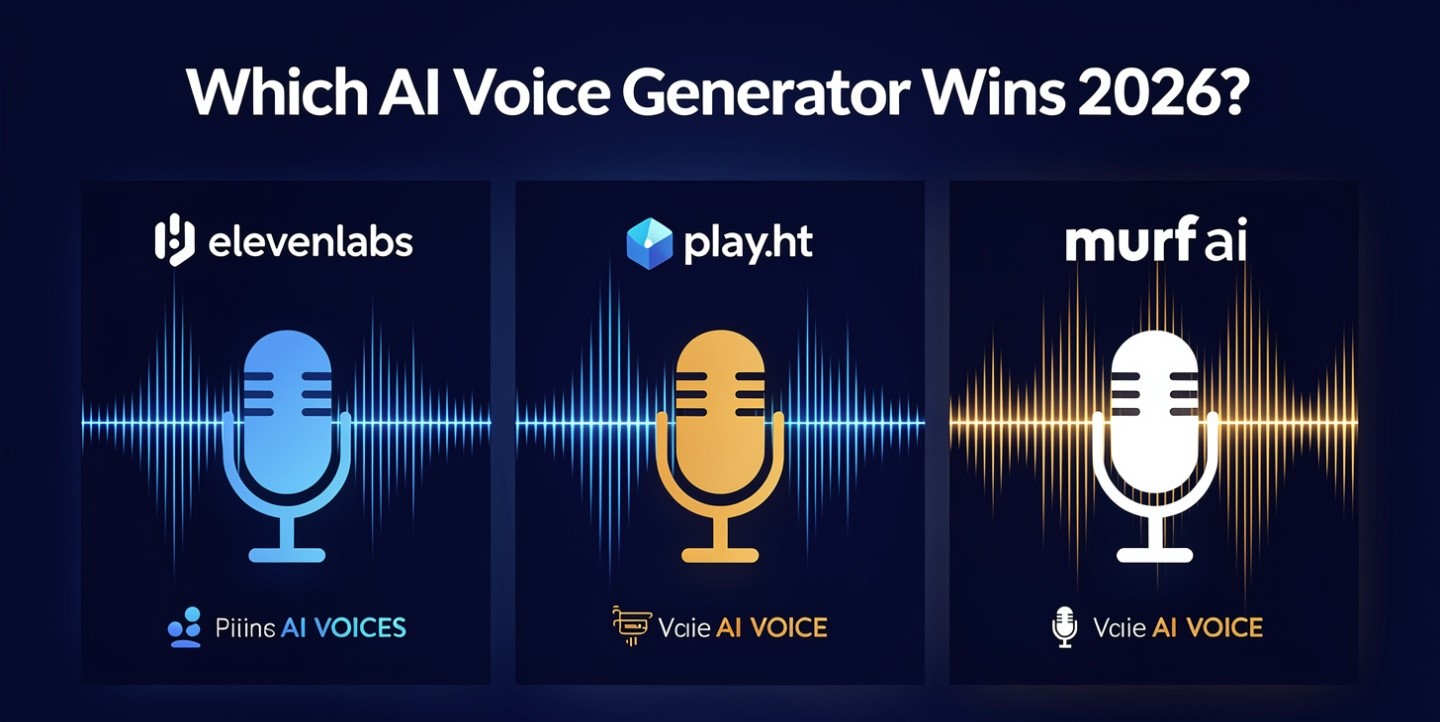
Start with the thing that makes this comparison different from every other one you’ll find: PlayHT no longer exists. Not “declining,” not “pivoting” — shut down, domain dark, accounts deleted.
So an ElevenLabs vs PlayHT vs Murf comparison in 2026 is really a two-way decision plus a cautionary tale. The tale is the more useful half, because it tells you something about buying AI voice tools that no feature table will.
What happened to PlayHT
In July 2025, Meta acquired PlayAI — formerly PlayHT — confirming the deal to Bloomberg without disclosing a price. An internal memo reported the entire team, around 35 people, joining the company, folded into its superintelligence lab to work on Meta AI, AI Characters and wearables (Engadget, Yahoo Finance). The company had raised roughly $21.75M since 2016 (CB Insights).
This was an acqui-hire. Meta wanted the team and the technology, not the subscription business. What followed:
- The public API went offline weeks ahead of the announced sunset, catching developers mid-integration.
- The service terminated permanently on 31 December 2025 — studio, API, accounts, saved audio and voice clones.
- There is no successor product and no “PlayHT 2.0.” Any site claiming to be the new Play.ht is unrelated.
Murf published a migration guide for displaced users at the time, noting that conversational AI platforms had already begun steering customers away as the API disappeared (Murf’s transition guide).
An honesty note. While researching this, I found voice-tool roundups updated as recently as June 2026 that still list Play.ht among their top recommended alternatives, six months after it stopped resolving. If you’re comparing AI voice tools right now, that’s a reminder to check whether the product still exists before you check whether it’s good.
The lesson worth more than the comparison
A voice clone is not a file you own. It’s a model living on someone else’s infrastructure, in a format with no export standard, and there is no way to move it. When PlayHT closed, users who hadn’t kept their original training audio couldn’t rebuild their voice anywhere — a clone can’t be transferred, only recreated from source recordings you still hold.
Four rules follow, and they apply to whichever platform you choose:
- Keep every source recording. The training audio is the only portable asset in the entire arrangement. Store it somewhere that isn’t the vendor.
- Download rendered audio as you go. Cloud-hosted projects vanish with the account. Local files don’t.
- Think hard before a cloned voice becomes your brand. If your entire course library, IVR system or channel is fronted by one synthetic voice, you’ve made a single vendor load-bearing for your identity.
- Prefer vendors where the clone is reconstructible. Not because it transfers — it doesn’t — but because rebuilding is cheap when you kept the inputs.
This is the same dependency, from a different direction, as the avatar-revocation problem in the Synthesia review: there the person can withdraw the likeness, here the vendor can withdraw the platform. Either way, a synthetic identity you rent is a business risk you should price.
ElevenLabs vs Murf: they don’t sell the same unit
Here’s why most head-to-head comparisons are useless. ElevenLabs meters characters. Murf meters hours of generated audio. Until you convert them, the prices are not comparable.
A workable conversion: natural narration runs somewhere near 1,000 characters per minute of speech. It varies with pacing and language, so treat it as an estimate for budgeting, not a guarantee.
| Tier | Price | Allowance as sold | Roughly, in minutes |
|---|---|---|---|
| ElevenLabs Free | $0 | 10,000 credits, no commercial licence | ~10 min |
| Murf Free | $0 | 10 min total, no downloads, no commercial rights | ~10 min, once |
| ElevenLabs Starter | ~$5 | 30,000 credits | ~30 min/mo |
| Murf Creator | $29 monthly / ~$19 annual | ~2 hrs/mo (24 hrs/yr) | ~120 min/mo |
| ElevenLabs Creator | $22 | 100,000 credits | ~100 min/mo |
| Murf Business | $99 monthly / ~$66 annual | ~8 hrs/mo (96 hrs/yr on annual) | ~480 min/mo |
| ElevenLabs Pro | $99 | 500,000 credits | ~500 min/mo |
Convert them and something unexpected appears: at comparable tiers the two are priced within touching distance of each other. Murf Creator gives roughly two hours for $19–29; ElevenLabs Creator gives roughly 100 minutes for $22. Murf Business is about eight hours for $99 monthly; ElevenLabs Pro is about eight hours for the same $99.
Price is therefore not the deciding factor between them, which is the opposite of what most comparison pages imply. Neither platform rolls unused allowance forward.
One reported oddity worth verifying yourself before you commit: at least one tracker states that Murf’s Business plan delivers less total generation on annual billing than on monthly (96 hours a year versus a monthly-billing equivalent nearer 240). If you’re a heavy user, check the annual allowance at checkout rather than assuming the discount is free money. This is the kind of billing-model detail that decides whether AI actually saves anything, covered more generally in cutting business costs with AI.
The one difference that actually decides it
Voice cloning on Murf is Enterprise-only. Not Creator, not Business. You engage sales, sign a contract, and reported figures land in the region of $1,000–5,000+ per year.
ElevenLabs puts instant cloning on its ~$5 tier and professional cloning on the $22 Creator plan.
That’s a difference of two orders of magnitude for the same category of feature, and it settles the decision for most readers before anything else gets discussed. If you need your own voice, or a client’s, ElevenLabs is the practical answer at small scale. Just be clear that unlocking the feature is not the same as acquiring the right to use someone’s voice — that distinction is the whole subject of the ElevenLabs review and it doesn’t change based on which platform you pick.
Murf’s cloning itself is capable when you get to it — rapid cloning from a couple of minutes of clean audio, professional cloning from around 90 minutes with a multi-week training period, and cloned voices that carry across 20+ languages. It’s an enterprise feature priced as one.
Studio versus engine
Underneath the pricing, these are different shapes of product.
Murf is a studio. A browser-based editor with a timeline, emphasis and pronunciation controls, a licensed soundtrack library, and integrations into Canva, PowerPoint and Google Slides. It’s built so that a marketer or instructional designer can go from script to finished narrated asset without leaving the tool. It also carries the compliance certifications procurement teams ask for — SOC 2, ISO 27001, and ISO 42001 for AI management systems, which is still uncommon.
ElevenLabs is an engine with a front end attached. Its centre of gravity is the API, the voice library and the quality of the model. The production workflow around it is thinner, and it expects you to bring your own editor.
That difference maps cleanly onto who you are. If your output is narrated slides, course modules and explainers, the studio saves you real time — the workflow context in AI for elearning and course creators is exactly Murf’s home ground. If you’re feeding audio into a video editor anyway, as in Descript vs CapCut, the studio features are redundant and you’re buying the voice alone.
Both free tiers are demos, not tiers
Worth stating plainly because it’s the most common wasted evaluation. Murf’s free plan blocks downloads and commercial use. ElevenLabs’ free tier carries no commercial licence.
You can assess voice quality on either. You cannot ship anything from either. Budget from the paid tier from the start.
Who should buy which
| If you are | Choose | Why |
|---|---|---|
| A creator needing your own cloned voice | ElevenLabs | Cloning at $5–22 vs an enterprise contract |
| Producing narrated courses or slide decks | Murf | The editor and integrations are the product |
| A developer building voice into an app | ElevenLabs | API-first, deeper voice library |
| A team in a regulated industry | Murf | SOC 2, ISO 27001 and ISO 42001 answer procurement’s questions |
| Producing high volume with stock voices | Either — run the conversion | Costs converge; workflow fit decides |
| Needing occasional functional narration | Neither | Commodity TTS in your OS or editor is free and good enough |
That last row matters more than it looks. Both platforms sell a quality premium, and a quality premium is only worth paying when the audience is paying attention to the voice. Internal training, accessibility narration and quick social captions rarely qualify — the same logic that governs which AI spending actually returns anything for content creators on YouTube and TikTok.
If you’re migrating from PlayHT
The practical position, honestly stated: your voice clones are gone and cannot be recovered from Meta. If you saved your original training recordings, you can rebuild an equivalent voice on ElevenLabs’ professional cloning tier. If you didn’t, you’re starting over with new source audio.
Rendered audio you downloaded before the cutoff is yours and unaffected. Anything left in the cloud is not recoverable.
Rebuild in this order: re-record clean source audio, clone on a platform that lets you do it without a sales call, download every finished asset locally as you produce it, and keep the source recordings somewhere permanent. The second time around, assume the platform is temporary.
For where voice sits in a wider stack, the best AI tools for small business owners has the map, and making AI videos for social media without editing skills covers the video side that usually sits downstream.
Frequently asked questions
Is PlayHT still available in 2026?
No. Meta acquired PlayAI, formerly PlayHT, in July 2025, and the service was permanently terminated on 31 December 2025. The studio, the public API, user accounts, saved audio and voice clones were all shut down, and the domain no longer resolves. There is no successor product.
Can I recover my PlayHT voice clones?
No. Voice clones cannot be transferred between platforms in any case, and PlayHT’s hosted data was deleted at shutdown. If you still hold your original training recordings you can rebuild an equivalent voice elsewhere; if not, you need new source audio.
Is ElevenLabs or Murf cheaper?
They’re close once you convert units. ElevenLabs sells characters and Murf sells hours; at roughly 1,000 characters per minute of speech, ElevenLabs Creator at $22 is about 100 minutes a month and Murf Creator at $19–29 is about two hours. At the tier above, both land near eight hours for $99 monthly. Price shouldn’t be the deciding factor between them.
Does Murf include voice cloning?
Only on Enterprise. Creator and Business plans do not include it, so cloning requires a sales conversation and a contract, with reported figures in the $1,000–5,000+ per year range. ElevenLabs offers instant cloning from around $5 a month and professional cloning at $22.
Can I use the free plans commercially?
No. Murf’s free plan blocks downloads and commercial use, and ElevenLabs’ free tier carries no commercial licence. Both are for evaluating voice quality only.
How do I avoid losing a voice if a platform shuts down?
Keep your original training recordings outside the vendor, download every rendered file locally rather than relying on cloud projects, and avoid making a single synthetic voice load-bearing for your brand identity. Clones are not portable, so the source audio is the only asset that survives a shutdown.