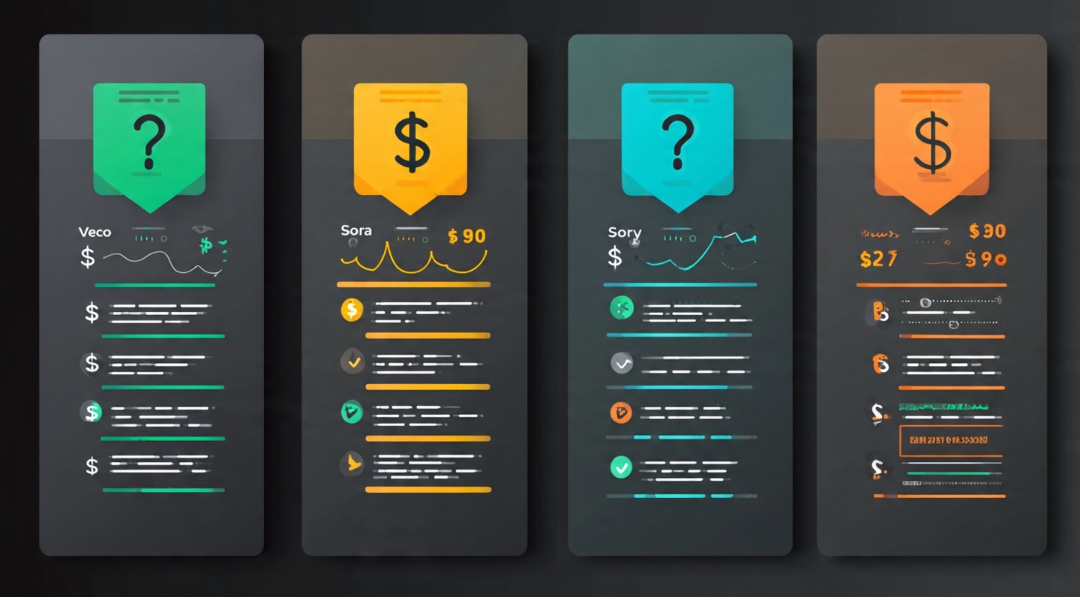
Ask which is cheaper — Veo vs Sora, or either against Runway — and there’s no clean answer, for a reason that’s more interesting than the usual “it depends.” All three tools price by the second, all three split access across a subscription-credits route and a pay-per-second API route, and for Google’s Veo specifically, independent pricing trackers checking the same tier within weeks of each other report per-second rates that differ by more than 20x. That’s not a typo. Before comparing these three tools on features, the pricing confusion itself needs sorting out, because it changes which one is actually affordable for what you’re building.
The Three Tools, Briefly
Veo is Google DeepMind’s video model, reached through the free-tier Gemini app, Google’s Flow creative tool (subscription-bundled AI credits), or pay-per-second access via Vertex AI and the Gemini API for developers. Sora 2 is OpenAI’s video model; its standalone consumer web and iOS app were discontinued on April 26, 2026, so consumer access now runs entirely through ChatGPT Plus or Pro subscriptions, with a separate usage-based API for developers. Runway, covered in more detail in this site’s Runway ML review, has repositioned itself as a storefront offering its own Gen models alongside licensed access to Veo, Kling and Seedance rather than competing purely as a single flagship model — a positioning closer to how a video editor like the one compared in this site’s Descript vs CapCut breakdown sits alongside a single-model generator than to a head-to-head model rivalry.
Why Nobody Can Agree on What Veo Costs
This is the part worth slowing down for. Multiple independent pricing trackers, checked against what they each describe as Google’s own current documentation, report meaningfully different numbers for what’s nominally the same access route.
| Reported rate | Tier described | Source type |
|---|---|---|
| $0.03/second | Veo 3.1 Lite, 720p, no audio | Third-party pricing tracker |
| $0.15/second | Veo 3 Fast, API | Third-party pricing tracker |
| $0.40/second (1080p) – $0.60/second (4K) | Veo 3.1, video with audio | Third-party pricing tracker / OpenRouter listing |
| $0.50/second | Veo 2, Vertex AI | Third-party pricing tracker |
| $0.75/second | Veo 3.1, Vertex AI / Gemini API | Third-party pricing tracker |
Some of that spread is genuinely explained by resolution, audio, and which specific sub-model (Lite, Fast, Standard, Quality) is being quoted — Google does run several tiers, and the cheapest and most expensive ones are not the same product. But the trackers don’t consistently label which of those variables they’re quoting, which is exactly how a reader ends up budgeting off a $0.03 headline number and getting billed at $0.75. None of these figures come from Google’s own pricing page directly in what’s checked here — they’re third-party trackers, several of which explicitly say they verified against Google’s current docs on a specific date. Before committing a production budget, check Google’s own Gemini API and Vertex AI pricing pages directly, on the day you’re budgeting, rather than trusting any single third-party number — including the ones in this table. The same “check the source, not the summary” discipline applies to deciding between free and paid AI tools generally, where headline numbers just as often skip the fine print.
Sora’s Path Got Simpler, Then Got a Deadline
Sora’s pricing structure is more consistent across sources than Veo’s, likely because the standalone consumer product no longer exists to confuse things. Since the April 26, 2026 shutdown of the consumer app, the two remaining official routes are a ChatGPT Plus or Pro subscription, or the developer API at a reported $0.10 per second for Sora 2 Standard at 720p, rising to a reported $0.30–$0.70 per second for Sora 2 Pro depending on resolution. One detail matters more than any of those numbers if you’re building anything that depends on Sora long-term: at least one pricing tracker reports OpenAI has scheduled the Sora 2 API to stop accepting requests on September 24, 2026. That’s a single-source report, not something confirmed here from OpenAI directly, but it’s serious enough that anyone building a pipeline on Sora right now — including anyone following the workflows in this site’s guide to creating AI videos for social media — should treat it as a live risk and have a fallback model ready, not something to verify after the fact.
Runway’s Numbers, Recapped
This site’s existing Runway review already covers the mechanics that matter most: the Unlimited plan is being retired in favor of a Max plan, credit consumption means the Standard tier buys roughly 25 seconds of flagship-quality video a month, and failed generations still spend credits — a detail that applies just as much to Veo and Sora, where retries are consistently flagged by trackers as the real cost driver beyond the advertised per-second rate — the same commercial-use caution this site raised when comparing image generators in Midjourney vs DALL-E vs Firefly applies to video output used commercially, and anyone publishing the results should also check the disclosure rules covered in this site’s guide for YouTube and TikTok creators.
Normalizing the Comparison: Cost of One 8-Second Clip
Per-second rates are hard to compare directly because tools default to different resolutions, audio settings and clip lengths. Using the lower, standard-quality figures most consistently reported for each tool, here’s roughly what an 8-second clip costs through the API/pay-per-use route, before retries:
| Tool | Standard-tier rate | Approx. cost, 8-second clip |
|---|---|---|
| Veo 3.1 Lite (no audio, 720p) | ~$0.03/second | ~$0.24 |
| Sora 2 Standard (720p) | ~$0.10/second | ~$0.80 |
| Veo 3.1 (1080p, with audio) | ~$0.40/second | ~$3.20 |
| Sora 2 Pro (higher resolution) | ~$0.30–$0.70/second | ~$2.40–$5.60 |
Treat every figure in that table as a starting point, not a quote — resolution, audio, retries and which specific sub-model you’re actually billed against will move the real number, sometimes by several multiples, as the Veo figures above already demonstrate.
Which Route Fits Which Use Case
For manual, occasional video creation, subscription-and-credits routes make more sense than the API: Google’s Flow inside a Google AI subscription, or a ChatGPT Plus/Pro subscription for Sora, absorb generation costs into a flat monthly fee, and you’re not tracking per-second math for every clip. For an app, product, or content pipeline generating video programmatically, the API route is the only one that makes sense operationally — but given the Veo pricing confusion and Sora’s reported API sunset date, budget for volatility, not a fixed rate — the same “what happens at the wall” question this site raised about metered coding tools like Cursor, Claude Code and GitHub Copilot applies just as much here, and revisit your numbers against the vendor’s own page more often than you would for a stable SaaS subscription.
Who Shouldn’t Build a Production Pipeline on Any of These Right Now
If your business depends on predictable, unchanging unit costs — the way you’d want from a payment processor or a hosting bill — none of these three tools currently offers that. Runway is mid-transition off its Unlimited plan, Veo’s own pricing can’t be pinned to one confirmed number across independent trackers, and Sora’s API has a reported sunset date less than a month out at the time of writing. None of that means don’t use them — it means don’t hardcode today’s rate into your own product’s pricing, and check each vendor’s current page before every budgeting cycle rather than relying on last quarter’s numbers, including the ones in this article.
Frequently Asked Questions
Which is cheaper, Veo or Sora?
It depends heavily on which tier of each you’re comparing. At the cheapest reported tiers, Veo 3.1 Lite (around $0.03/second) undercuts Sora 2 Standard (around $0.10/second), but Veo’s higher tiers are reported anywhere from $0.40 to $0.75 per second, well above Sora 2 Pro’s reported $0.30–$0.70 range — so the honest answer is that the ranking flips depending on quality tier, not a fixed fact about either tool.
Is Sora still available as a standalone app?
No. OpenAI discontinued the standalone Sora consumer web and iOS app on April 26, 2026. Access now runs through a ChatGPT Plus or Pro subscription, or the developer API.
Why do different sources quote such different prices for Veo?
Google runs several Veo sub-tiers (Lite, Fast, Standard, Quality) at different resolutions and with or without audio, and third-party trackers don’t consistently specify which tier they’re quoting. That produces reported figures ranging from around $0.03 to $0.75 per second for what get described loosely as “Veo pricing.”
Is it true Sora’s API is shutting down?
At least one pricing tracker reports OpenAI has scheduled the Sora 2 API to stop accepting requests on September 24, 2026. This is a single-source report, not confirmed directly from OpenAI here, but anyone building on the Sora API should treat it as a real risk and prepare a fallback.
Does Runway compete directly with Veo and Sora?
Not exactly — Runway has positioned itself as a storefront offering its own models alongside licensed access to Veo, Kling and Seedance, rather than purely competing as a single flagship model the way Sora and Veo do.
What’s the biggest hidden cost across all three tools?
Retries. Multiple pricing trackers across all three tools note that failed or unsatisfactory generations still consume credits or billed seconds, and iteration — not the advertised per-second rate — is usually the largest real-world cost driver.