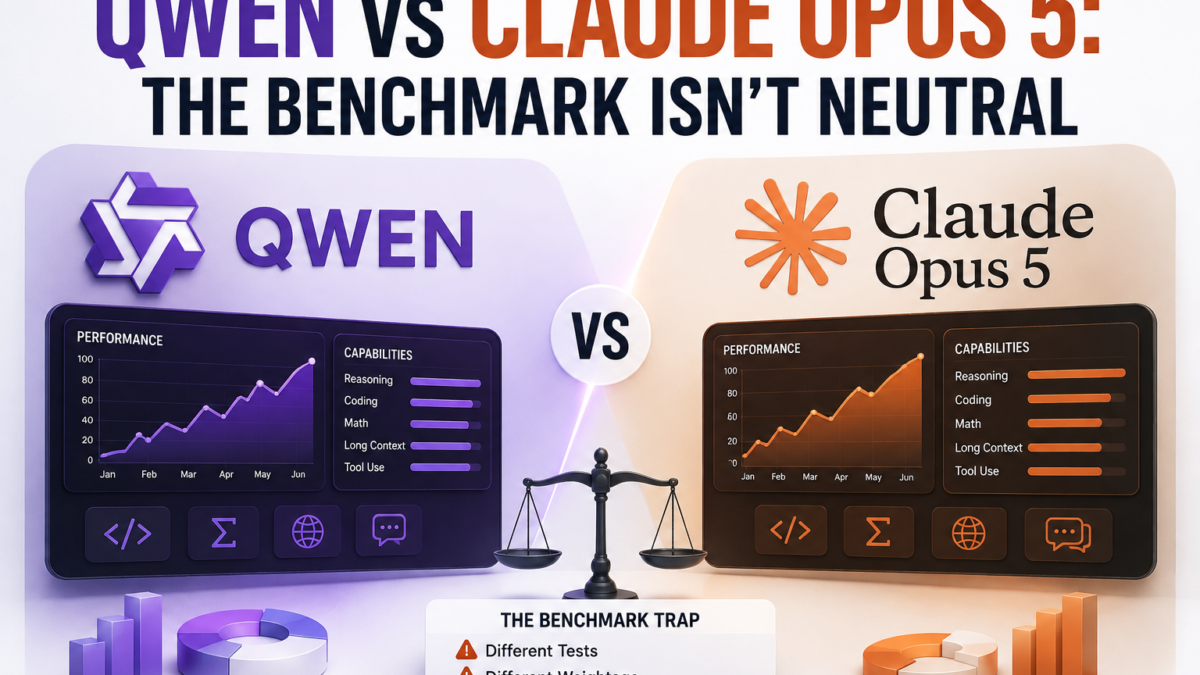
Alibaba’s September 1, 2026 update to its flagship model reignited the same comparison everyone runs whenever a new frontier model ships: Qwen vs Claude, head to head, benchmark table open. That comparison is measuring less than it looks like it is. Most of the coding benchmarks Alibaba published to make its case were run using Anthropic’s own Claude Code harness — the same tool this site recently covered as a variable that can swing results by as much as switching model generations entirely. Before deciding whether Qwen3.8-Max-0902 actually beats Claude Opus 5, it’s worth understanding what the comparison is actually testing — the same care this site takes whenever it lines up ChatGPT, Claude and Gemini against each other.
What Actually Shipped
Qwen3.8-Max-0902 is a post-training refresh of Alibaba’s flagship, not a new model architecture. The base stays the same 2.4-trillion-parameter mixture-of-experts design with roughly 95 billion active parameters, the same 1-million-token context window, and — notably — the same pricing as the original Qwen3.8-Max: $2 per million input tokens and $6 per million output tokens. Alibaba’s own release notes describe the update as sharper coding capability for “engineering-scale projects and long-horizon autonomous development,” improved multi-tool orchestration, and refined visual reasoning for charts and documents. It follows the original Qwen3.8-Max, which launched August 3, 2026.
Where It Actually Beats Opus 5, and Where It Doesn’t
Alibaba’s own published comparison table shows a genuinely mixed result, not a clean win for either side.
| Benchmark | Result |
|---|---|
| Code Arena WebDev | Qwen3.8-Max-0902 ranks first overall (1,691), ahead of Claude Opus 5 Max (1,687) and Kimi K3 Max (1,674) |
| MLS-Bench-Lite, SWE-Atlas QnA, QwenSWEBench V2 | Qwen3.8-Max-0902 leads Claude Opus 5 |
| WorkArena and both published multimodal evals | Qwen3.8-Max-0902 wins |
| TerminalBench 3.0, DeepSWE 1.1, agent coordination benchmarks | Claude Opus 5 still leads |
Read that as what it is: a real, meaningful jump for Qwen on several specific benchmarks, sitting alongside categories where Opus 5 is still ahead. Anyone summarizing this as a flat “Qwen beats Claude” or “Claude still wins” headline is dropping half the table.
The Confound Nobody’s Flagging
Here’s the detail that changes how much weight to put on any of this: for most of its coding benchmark comparisons, Alibaba ran the models through Anthropic’s own Claude Code harness rather than a neutral, third-party evaluation tool. That matters because this site’s own recent coverage of how much the harness itself changes results found controlled tests where swapping only the harness — with the identical model — moved cost per task by more than 2x and pass rate by several percentage points, a swing comparable to moving up a full model generation. Running Qwen’s coding evaluation through a harness Anthropic built for its own model isn’t necessarily unfair — it does mean the benchmark table isn’t measuring two models on genuinely neutral ground, and a harness tuned around one vendor’s calling conventions and tool-use patterns may not extract the same performance from a different model family. Treat any coding benchmark run this way as a comparison of “Qwen through Anthropic’s harness” versus “Claude through its own native harness,” not “Qwen versus Claude” in the abstract — the same caution applies to any open-weight coding model benchmarked this way, including GLM-5.3, and to routing decisions made through an aggregator like OpenRouter, where the harness sitting on top of the model can matter as much as which model gets routed to underneath.
The Sticker Price Hides the Real Bill
The headline pricing — $2 per million input tokens, $6 per million output — genuinely didn’t change with this update, and multiple independent trackers confirm the same figures. What the sticker price doesn’t make obvious is that Qwen3.8-Max’s default reasoning effort level is set to its highest tier, and reasoning tokens are billed as output tokens at the full $6 rate. A request that looks like it should cost pennies based on the visible final answer can run considerably higher once the reasoning tokens behind that answer are counted — budgeting off visible output length alone will understate the real bill. Cache economics complicate the picture further: in a typical agent loop where most input ends up served from cache, one pricing breakdown put the effective input rate closer to $0.78 per million tokens rather than the headline $2, because repeated context gets billed at a fraction of the standard input rate.
| What you might assume | What actually happens |
|---|---|
| Cost tracks the $2/$6 headline rate | Reasoning tokens bill as output at $6/M by default, at the highest effort tier |
| Every input token costs the same | Cached input in an agent loop can effectively run closer to $0.78/M |
| “Roughly a third of Opus 5” settles the cost comparison | That figure compares list prices only, not real agent-loop billing on either side |
Normalizing the Cost Story
One tracker’s framing put Qwen3.8-Max’s list pricing at roughly a third of Claude Opus 5’s and about a quarter of GPT-5.6 Sol’s. That’s a fair comparison of sticker prices, and worth knowing — but it’s a vendor-adjacent tracker’s characterization, not an independently audited total-cost comparison across real agent workloads on all three models, and it doesn’t account for the reasoning-token and caching dynamics above, which apply differently depending on how each vendor structures its own billing. The same “check past the headline number” habit this site recommends when weighing free versus paid AI tools applies just as much to a per-token sticker price as it does to a subscription tier.
Who Should Actually Switch
If your workload is genuinely price-sensitive and falls into the categories where Qwen3.8-Max-0902 already leads — web development-style coding tasks, document and chart-heavy multimodal work, long-horizon agent orchestration — the list-price gap alone makes it worth a real trial against your own tasks, the same discipline covered in comparing metered coding tools generally. If your workload leans on the specific benchmarks where Opus 5 still leads — terminal-heavy agentic work, complex multi-tool coordination — switching on the strength of this comparison table alone is premature, especially given how much of that table ran through a harness built for the competing model. Either way, model your actual cost at your default reasoning effort setting before assuming the $2/$6 headline is what you’ll pay, and see this site’s Claude AI review for the usage-limit side of the Anthropic comparison, since sticker price isn’t the only constraint that determines real cost.
Frequently Asked Questions
Does Qwen3.8-Max-0902 beat Claude Opus 5?
On some benchmarks, yes — it leads on Code Arena WebDev, MLS-Bench-Lite, SWE-Atlas QnA, QwenSWEBench V2, WorkArena, and multimodal evaluations. Claude Opus 5 still leads on TerminalBench 3.0, DeepSWE 1.1, and agent coordination benchmarks. There’s no single winner across the board.
Why does the harness used for benchmarking matter?
Alibaba ran most of its coding comparisons through Anthropic’s own Claude Code harness. Independent testing has found that harness choice alone, with an identical model, can change cost per task by more than 2x and pass rate by several percentage points — so a benchmark table built on a harness designed around one vendor’s model may not treat both models equally.
Did Qwen3.8-Max-0902’s pricing change from the original Qwen3.8-Max?
No. Pricing stayed at $2 per million input tokens and $6 per million output tokens, unchanged from the original August 3, 2026 release.
Why might my actual bill be higher than the $2/$6 headline rate suggests?
Qwen3.8-Max defaults to its highest reasoning effort tier, and reasoning tokens bill as output tokens at the full rate. A response that looks short based on the final visible answer can involve significantly more billed reasoning tokens behind it.
Is Qwen3.8-Max-0902 really a third of the price of Claude Opus 5?
That figure, cited by at least one pricing tracker, compares list prices only. It doesn’t account for reasoning-token billing defaults or cache-driven effective rates on either model, so treat it as a starting point rather than a full cost comparison.
Is Qwen3.8-Max-0902 a new model or an update?
It’s a post-training update to the existing Qwen3.8-Max, not a new architecture. The parameter count, context window, and pricing are unchanged; the update focuses on coding and agentic task performance.